
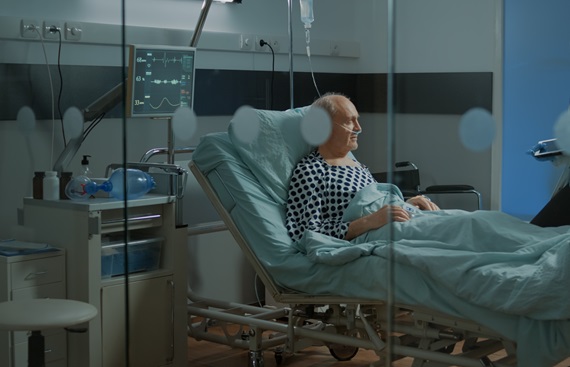
The Cath Lab at Vakratunda Hospital And Research Institute is a dedicated interventional cardiac facility equipped for high-acuity diagnostic and therapeutic procedures. It operates as an integrated unit within the Cardiac Sciences Department — connected directly to the ICCU, emergency services, and operating theatres through defined clinical pathways.
Every procedure performed in the Cath Lab follows a structured workflow — from pre-procedure patient preparation and imaging review to intra-procedure haemodynamic monitoring and post-procedure ICCU handoff.
The Cath Lab operates on a structured 5-step workflow. For STEMI emergencies, door-to-balloon time is targeted under 90 minutes — supported by pre-activated team alerts, parallel prep protocols, and direct ICCU handoff.
Patient history, allergy check, contrast precautions, and baseline ECG/Echo reviewed. Consent obtained and pre-medication administered per protocol.
Real-time coronary imaging performed with digital subtraction angiography. Images reviewed immediately by the interventional cardiologist for lesion assessment.
Lesion severity evaluated using imaging and haemodynamic data. Treatment decision — angioplasty, stenting, or surgical referral — made within the Cath Lab.
Angioplasty or stenting performed under continuous fluoroscopic guidance. Haemodynamic parameters monitored throughout. Radiation dose tracked per session.
Structured handoff to ICCU team with documented procedure summary. Continuous monitoring for 24 hours. Repeat imaging scheduled at clinical discretion.
Code Heart activation bypasses routine workflow. Cath Lab team, ICCU, and anaesthesia notified simultaneously. Target: door-to-balloon under 90 minutes.
Patient identity, allergy status, contrast clearance, anticoagulation dose, and informed consent verified at three checkpoints before catheter insertion.
Fluoroscopy time and dose tracked per case. Lead shielding, dosimetry badges, and patient dose log maintained per AERB radiation safety guidelines.
Contrast-induced nephropathy risk assessed pre-procedure. Hydration protocol activated for at-risk patients. Emergency contrast reaction kit available in lab.
Heparin dosing follows weight-based protocol with ACT monitoring during procedure. Reversal agents immediately accessible within the Cath Lab.
Full decontamination protocol between procedures. Sterile draping, antibiotic prophylaxis, and access site care follow vascular infection prevention standards.
Complication rates, door-to-balloon times, stent success rates, and contrast volumes tracked monthly. Reviewed at Cardiac Department quality meetings.
Digital Subtraction Angiography with high-resolution fluoroscopy for real-time coronary and peripheral vessel imaging
Cath Lab imaging archived and accessible instantly to cardiologists, ICCU, and surgical teams via hospital PACS network
Continuous intra-procedure haemodynamic monitoring — BP, HR, SpO2, and ECG displayed on dedicated Cath Lab console
Structured digital procedure summary transferred to ICCU team via EMR at case completion — eliminating verbal-only handoffs
Diagnostic imaging to evaluate coronary artery disease, blockages, and vessel anatomy.
Balloon angioplasty and stent placement to restore blood flow in blocked coronary arteries.
Vascular imaging for peripheral artery disease evaluation and intervention planning.
Emergency angioplasty for acute heart attack. Activated via Code Heart with priority access to Cath Lab.
Bedside or Cath Lab pacemaker insertion for haemodynamically unstable bradyarrhythmias.
Structured imaging review and haemodynamic assessment before patient transfer to ICCU.
Door-to-Balloon Target
Emergency Availability
Direct Post-Procedure Link
Driven at Every Step